UX Research

Evidence over assumptions

Rigorous user research that replaces guesswork with behavioral data. I help teams understand what users actually do — not what they say they do — so you can build with confidence.

100s
Studies designed and run
1,000+
Participants interviewed and tested
8+
Years in UX research
6
Complex, regulated industries

Research services

How I help teams learn from their users

Four things teams usually come to me for. Most engagements combine two of them — a study rarely creates value on its own, but a study plus a shareout that moves a decision does.

User Research Studies

In-depth interviews, surveys, usability testing, and contextual inquiry designed to uncover the motivations, frustrations, and workarounds your users aren't telling you about.

  • Interviews
  • Usability testing
  • Surveys
  • Contextual inquiry

You end up with A research plan and screener, moderated sessions, a findings report with severity-ranked issues, and a highlight reel of the moments that make the case.

Research Synthesis & Shareouts

Turning raw data into strategic recommendations your team can act on. Journey maps, persona data, affinity diagrams, and executive-ready shareout decks that drive alignment.

  • Affinity mapping
  • Journey maps
  • Personas
  • Exec shareouts

You end up with A synthesis board you can audit, a decision-oriented shareout deck, and a prioritized recommendation set tied to owners.

Competitive & Market Research

Understanding the landscape your product lives in. I analyze competitor experiences and market expectations so your design decisions are informed by context, not just internal assumptions.

  • Heuristic benchmarking
  • Feature teardowns
  • Category conventions

You end up with A side-by-side comparison of the flows that matter, the conventions your users already expect, and the gaps worth owning.

Research Ops Consulting

Building your team's internal research capability. I help establish processes, tools, templates, and governance so research becomes a sustainable practice, not a one-off project.

  • Recruiting pipeline
  • Consent & privacy
  • Repository
  • Templates

You end up with A running recruiting pipeline, a consent and data-handling standard, a searchable insight repository, and templates your team actually uses.

Research delivered for

Intuit TurboTax
Verizon
Honda
Seattle Seahawks
EDF Energy
Lamps Plus

Engagement formats

Four ways to bring research in

Research goes wrong most often at the scoping stage, not the fieldwork stage. So every engagement starts as one of four shapes, with a fixed scope and a named end date — you always know what you are buying and when it lands.

Research Sprint

2–3 weeks one focused study
Fixed scope · one question answered

You have a specific decision in front of you and need evidence before you commit engineering time.

  • One method, 5–8 participants
  • Research plan, screener, and discussion guide
  • Moderated sessions with notes and clips
  • Findings report and live shareout
  • Best for: validating a flow, a concept, or a redesign
Scope a sprint

Embedded Research Partner

Monthly ongoing capacity
Retainer · a set number of days each month

You ship continuously and need research running at the same cadence, without hiring for a role you can't yet justify.

  • A standing study cadence your squads can book into
  • Attendance at planning and design reviews
  • Insight repository kept current, not archived
  • Async reviews of flows and prototypes between studies
  • Best for: teams between researcher hires
Check availability

Research Ops Setup

3–4 weeks capability build
Fixed scope · your team runs it after

Your team wants to run its own research, and keeps stalling on recruiting, consent, and where the findings live.

  • Recruiting and incentive pipeline set up end to end
  • Consent, privacy, and data-retention standard
  • Plan, guide, note-taking, and report templates
  • Insight repository with a tagging scheme
  • Two coached studies, so the process is proven before I leave
  • Best for: design teams with no dedicated researcher
Build the practice

Every engagement is quoted as a fixed scope after a free 30-minute call — no hourly meter, no change-order surprises. Published agency research programs commonly start in the mid five figures and run to six; an independent engagement is sized to the one question you actually need answered. If the honest answer is that you don't need research yet, I'll say so on the call.

Deliverables

What you actually receive

Six research artefacts laid out as document cards — research plan, discussion guide, screener, highlight reel, findings report, and a prioritised recommendation set shown last and highlighted.
Every engagement ends on the card at the bottom right: a ranked set of recommendations, not a deck of observations.

Six artefacts, in the order they arrive

Nothing here is a surprise on the last day. You see the plan before fieldwork starts and the findings before the report is written.

  • Research plan — questions, method, participant criteria, and what a decision-ready answer looks like.
  • Screener and recruiting — the criteria that keep the wrong participants out, and the pipeline that fills the sessions.
  • Discussion guide — the tasks and probes, reviewed with you before anyone is in the room.
  • Session recordings and a highlight reel — the two minutes of footage that end an internal debate.
  • Findings report — each finding with its severity, the evidence behind it, and what it costs you today.
  • Prioritized recommendations — sequenced by impact and effort, with the shareout that gets them agreed.
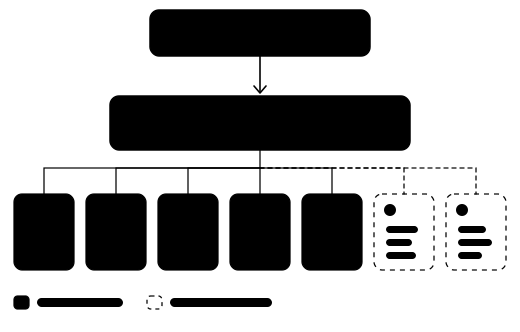
A recommendation card at the top, linked down to a finding and from there out to seven participant quotes — five supporting it and two dissenting, kept visible rather than dropped.
Each recommendation traces back to the sessions it came from — including the participants who disagreed.

Every claim traces back to a session

The fastest way for research to lose a room is a finding nobody can check. So findings are built to be audited rather than trusted.

  • Counted, not characterized — "6 of 8 participants" instead of "users felt".
  • Linked to evidence — every finding points at the clips and transcript moments underneath it.
  • Dissent stays in — participants who contradicted the pattern are reported, not quietly dropped.
  • Confidence is labeled — strong signals and early signals are marked differently, so you know which ones to bet on.
  • Separated from opinion — what we observed and what I recommend are kept in different columns.

Method choice

The right method for the question you're asking

Most wasted research spend comes from running the wrong study well. Usability testing can't tell you whether to build something; interviews can't tell you how many people are affected. This is the shortlist I choose from on a scoping call.

Method selection at a glance

Generative methods shape what to build. Evaluative methods check what you've built. Qualitative explains why; quantitative shows how many.

Common research methods by purpose and data type, with the question each one is genuinely good at answering.
Method Purpose Data Answers Typical sample
In-depth interviews Generative Qualitative What are people actually trying to get done, and what do they do when the product gets in the way? 6–12
Contextual inquiry Generative Qualitative What does the real workflow look like, including the spreadsheets and workarounds outside your product? 5–8
Diary study Generative Mixed How does behavior change over days or weeks, rather than in one session? 8–15
Survey Generative Quantitative How widespread is a behavior or attitude across the whole user base? 100+
Moderated usability test Evaluative Qualitative Where do people get stuck in this flow, and why does it happen? 5–8 per group
Unmoderated benchmark Evaluative Quantitative What are completion rates and times on task now, and did the redesign move them? 30–100
Heuristic / expert review Evaluative Expert judgement What is already known to be broken, before spending participant budget to confirm it? No participants
Competitive benchmark Evaluative Mixed What conventions do your users already expect because the rest of the category taught them? 3–6 products

Sample sizes are the ranges I plan against for most B2B and consumer products; regulated domains, low-incidence roles, and accessibility studies often need more recruiting time and a wider net. The method mix is set with you during scoping, not assumed here.

Methodology

A research process built on rigor

Frame

Week 1

Define research questions, align on objectives with stakeholders, and choose the right methods for the problem at hand. We write down what decision the findings have to serve.

Recruit

Week 1–2

Screen for the people who actually match the criteria, handle scheduling and incentives, and get consent in place before anyone joins a session.

Conduct

Week 2–3

Run the sessions with care, capture rich qualitative and quantitative data, and send you a short signal note after each block so nothing waits for the report.

Synthesize

Week 3–4

Analyze patterns, build frameworks, and distill findings into clear, actionable insights that connect to business outcomes — with the evidence attached.

Activate

Week 4 onward

Present findings in a format that drives decisions, then stay involved to review designs and make sure the insights turn into shipped changes.

Rigor and care

How participants and their data are handled

I've run research inside fintech, healthcare, and energy, where the review process is as real as the study. These are the defaults I bring in, so legal and security reviews don't become the reason a study slips.

Recruiting you can defend

Screeners written to exclude professional survey-takers and colleagues, with quotas agreed up front. I report who we actually reached — and who we couldn't — rather than presenting a convenient sample as representative.

Informed consent, every session

Participants know what is recorded, who sees it, how long it is kept, and that they can stop at any point. Consent is captured before the session, not asked for in the first minute.

Data handled minimally

Personal details are collected only where the study genuinely needs them, stored in your systems where you require that, de-identified in reporting, and deleted on the retention schedule we agree. NDAs and vendor security reviews are routine, not an obstacle.

Accessibility taken seriously

Sessions are run so assistive-technology users can take part, and studies include them where the product serves them. Findings note where a barrier is an accessibility failure rather than a general usability one.

Fit

Is this the right time for research?

A good fit

  • A significant build or redesign is about to be committed to.
  • Engagement, conversion, or support volume is moving and nobody can explain why.
  • The team has strong, conflicting opinions and no evidence to settle them.
  • You're entering a new segment, market, or user type.
  • Research happens occasionally, and the findings never quite reach the roadmap.
  • You need a researcher for a stretch, not a headcount.

Probably not yet

  • The decision is already made and research is wanted as cover for it.
  • Nobody on the team can act on the findings for the next two quarters.
  • The known usability problems haven't been fixed yet — start with an audit instead.
  • You need a full design team, not research; I'll point you to people who do that.
  • The question is purely about pricing, positioning, or market sizing.

What colleagues say

Research that teams trust

"Estele was instrumental in embedding user research into our product lifecycle and was an unwavering advocate for user needs. She is quick and effective in her approach, and has the uncanny skill of aligning stakeholders and leading teams toward consensus."

RM
Raine Medeiros
Content Design, Content Strategy · Intuit

"She brings warmth, professionalism, and sharp analytical thinking to every project. Her synthesis work is always clear, actionable, and intensely strategic. This skill was highly impactful in the fast-paced and highly technical environment we worked in together."

YG
Yesenia Gonzalez
Sr. Product Designer · Intuit

"Estele led an exceptional UX Research initiative. Her ability to design, execute, and communicate research findings is unmatched, and she has elevated the company's understanding of user needs to a whole new level."

SR
Samantha Ronjak
UX Researcher & Designer · EDF

How I think about the craft

Read before you hire me

Two pieces that cover most of what I'd tell you on a call — how studies get designed, and what it takes for findings to actually change a roadmap.

Questions

What teams usually ask first

What does a research engagement cost?
Every engagement is quoted as a fixed scope after a free 30-minute call, so the number you get is the number you pay. Cost is driven by three things: how many participants are needed, how hard they are to recruit, and how many methods the question requires. A single-method sprint is a fraction of a multi-method discovery program — and if a two-hour expert review would answer your question instead, I'll recommend that.
Who finds the participants?
Usually me. I write the screener, run recruiting through a panel or your own user base, handle scheduling, and manage incentives. If your users are specialists — clinicians, tax professionals, field engineers, enterprise admins — recruiting takes longer and I build that into the timeline rather than quietly loosening the criteria.
How quickly can we start, and how fast do findings arrive?
Scoping and recruiting typically take the first one to two weeks. You don't wait for the final report to hear anything: I send a short signal note after each block of sessions, so the team can start reacting while fieldwork is still running. A sprint lands in two to three weeks end to end; a discovery program runs four to eight with weekly checkpoints.
Do you work with our existing designers and PMs?
Yes — that's the normal case. I plug into your rituals, invite the team to observe sessions, and hand over the raw material rather than keeping it. The goal is that your designers can defend the recommendations after I'm gone, which means they need to have watched the sessions too.
What tools do you use?
Whatever your team already pays for, wherever possible — your call platform, your research and panel tools, your repository, your design files. If you have nothing in place, I'll set up a lightweight stack and hand it over documented, so it keeps working without me.
How do you handle NDAs, security reviews, and user data?
NDAs and vendor security reviews are routine. Recordings and personal data can stay in your systems if your policy requires it, participant details are collected only where the study needs them, reporting is de-identified, and everything is deleted on the retention schedule we agree up front.
What if the findings contradict what leadership wants to hear?
Then that's what the report says, with the evidence next to it. I'll help you frame it in terms of risk and cost rather than blame, and I'll separate what we observed from what I recommend so the team can disagree with my recommendation without having to dispute the data.
Can you run research in other time zones?
Yes. I'm based in the US and work worldwide; sessions get scheduled in participants' local hours, and I've run studies across multiple markets in a single program.


Stop guessing. Start knowing.

Book a free 30-minute scoping call. We'll turn your open question into a research question, pick the method that answers it, and agree what the deliverable needs to be — whether or not you hire me.

Book a Free Scoping Call